

This blog post contains affiliate links. If you purchase a product through my custom link, I will earn a commission at no extra cost to you. WIN!
How to Replace a BMW 3 Series & 4 Series Battery (F30, F32)
If your BMW is struggling to start, you don't necessarily need an expensive trip to the mechanic. Replacing the battery on an F30 (3 Series) or F32 (4 Series) is a straightforward DIY project.
Overview & Pricing
Difficulty: Easy / Moderate
Time Required: 30–45 minutes
Estimated Cost: $270 – $310 (OEM)
Fitment: BMW 3 Series (2012–2018) & 4 Series (2014–2020)
Symptoms of a Failing BMW Battery
Most BMW batteries have a lifespan of 5 to 7 years. If your battery is reaching this age, look for these common warning signs:
Slow Engine Crank: The car takes several attempts or "labors" to turn over.
Flickering Electronics: Interior lights or dashboard displays dim during ignition.
Increased Warning Lights: Older batteries cause voltage drops that trigger "Chassis Stabilization" or "Restraint System" malfunctions.
Dimming Headlights: Noticeable brightness changes while idling.
Pro Tip: Before buying a new unit, take your car to a local auto parts store for a free battery load test to confirm it’s the battery and not the alternator.
Buying Guide: OEM vs. Aftermarket
While generic auto-part store batteries are an option, many owners are surprised to find that Genuine BMW batteries are competitively priced. That being said, there are only a few suppliers for all brands of car batteries, so focus on specs and warranty rather than brand.
Note on Battery Registration: Regardless of which battery you choose, BMWs from 2006 onward (including the F30/F32) require battery registration. This tells the Intelligent Battery Sensor (IBS) that a new battery is present so it can adjust the charging profile.
BMW 3 Series & 4 Series Battery replacement guide
While some of the specs and hardware mentioned in this guide are specific to the F30 3 Series and F32 4 Series, the process of replacing a BMW battery is similar on most models from 2006 onward.
BMW F30 3 Series Battery Specs (as of August 2022)
Size: Group 49
Type: AGM
Amp Hours: 92ah
Cold Cranking Amps: 850CCA
BMW Part #: 61 21 5 A40
Tools Required
-10mm socket
-13mm socket
-socket extension
-Carly For BMW Adapter or any software that can register a BMW battery
Battery installation DIY
The battery is located in the trunk on the right hand side.
Step 1: Remove the battery cover from the trunk linker and remove two 10mm bolts for the retaining bracket.
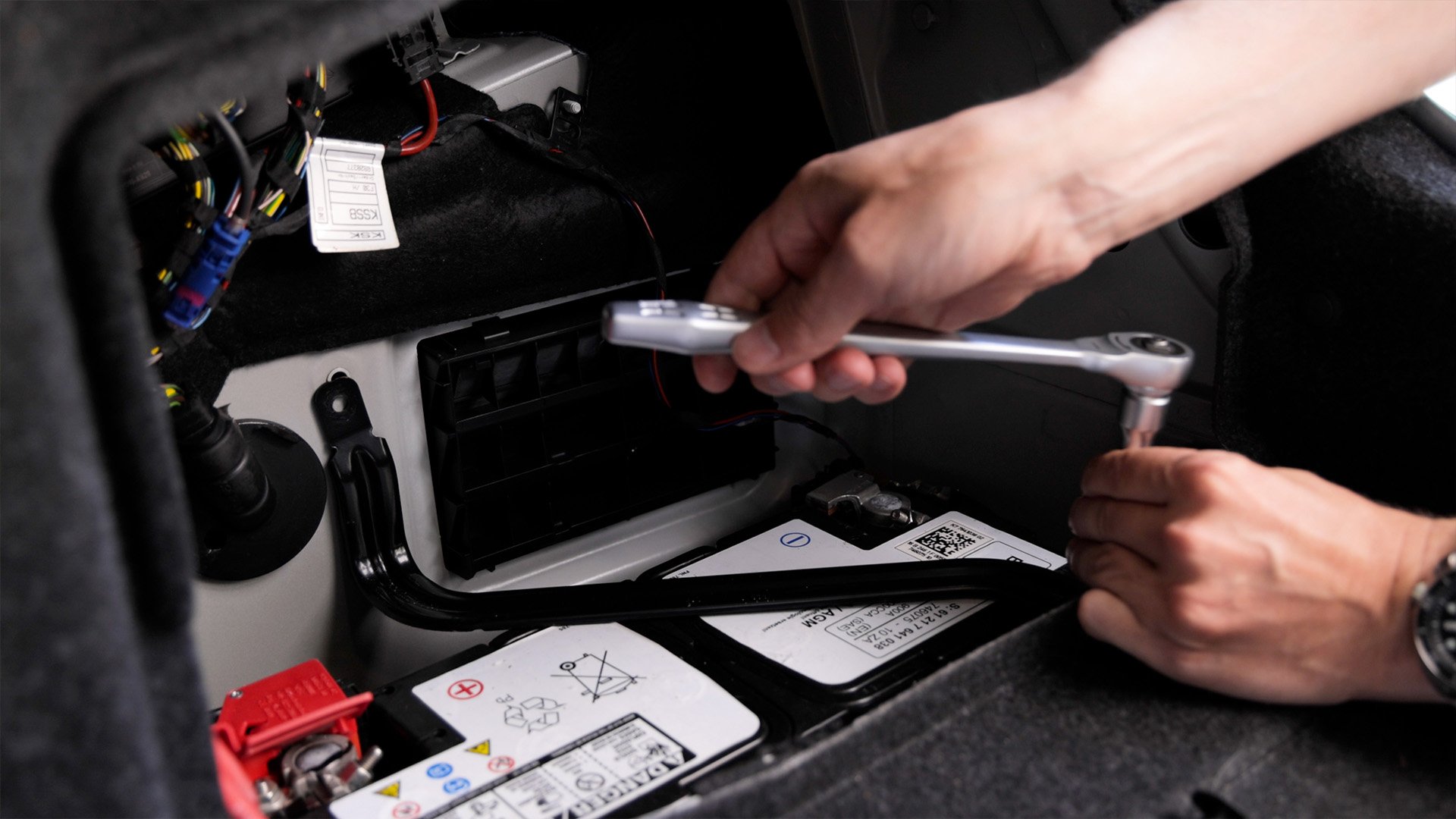
Step 2: Loosen the 10mm nut to remove the negative battery cable from the terminal.

Step 3: Loosen the 10mm nut on the positive battery cable and intelligent battery sensor and move it aside.

Step 4: Remove the vent hose located on the front side of the battery near the positive terminal. This vent allows gasses produced by the battery to escape out of the vehicle.
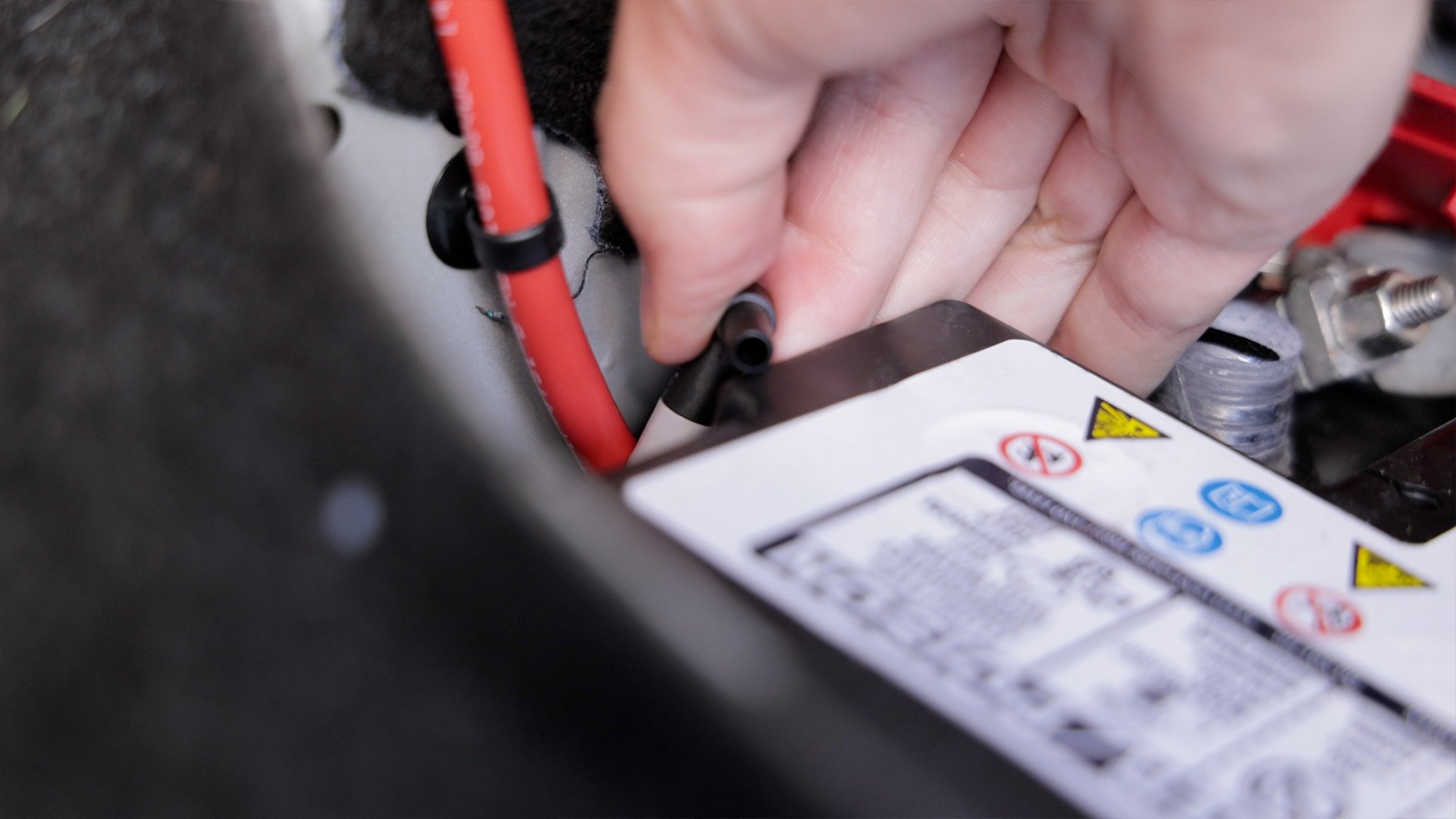
Step 5: Remove the 10mm bolt at the base of the battery on the negative side. You may need a long extension to reach it.
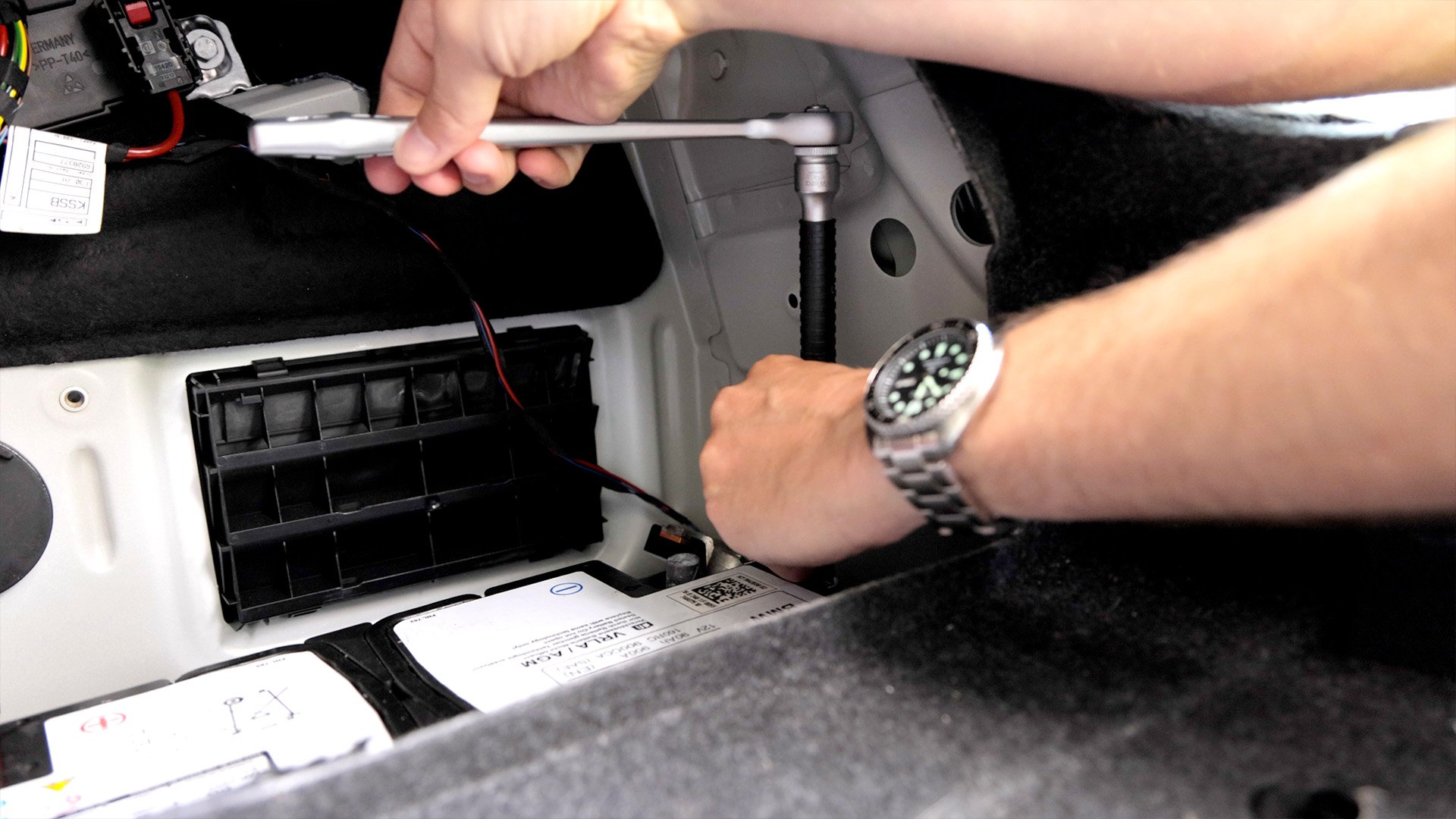
Step 6 (optional): I used masking tape to hold the negative and positive terminals out of the way during the battery removal and re-installation.

Step 7: Remove the old battery. Use proper lifting techniques as it is super heavy - 53 lbs (24 kg) to be exact, and it’s in an awkward spot in the trunk where you don’t have a lot of leverage.

Step 8: Install the new battery with the positive terminal towards the front of the car and the negative towards the rear. Don’t forget to remove the red plastic cover on the positive terminal or you won’t have power.
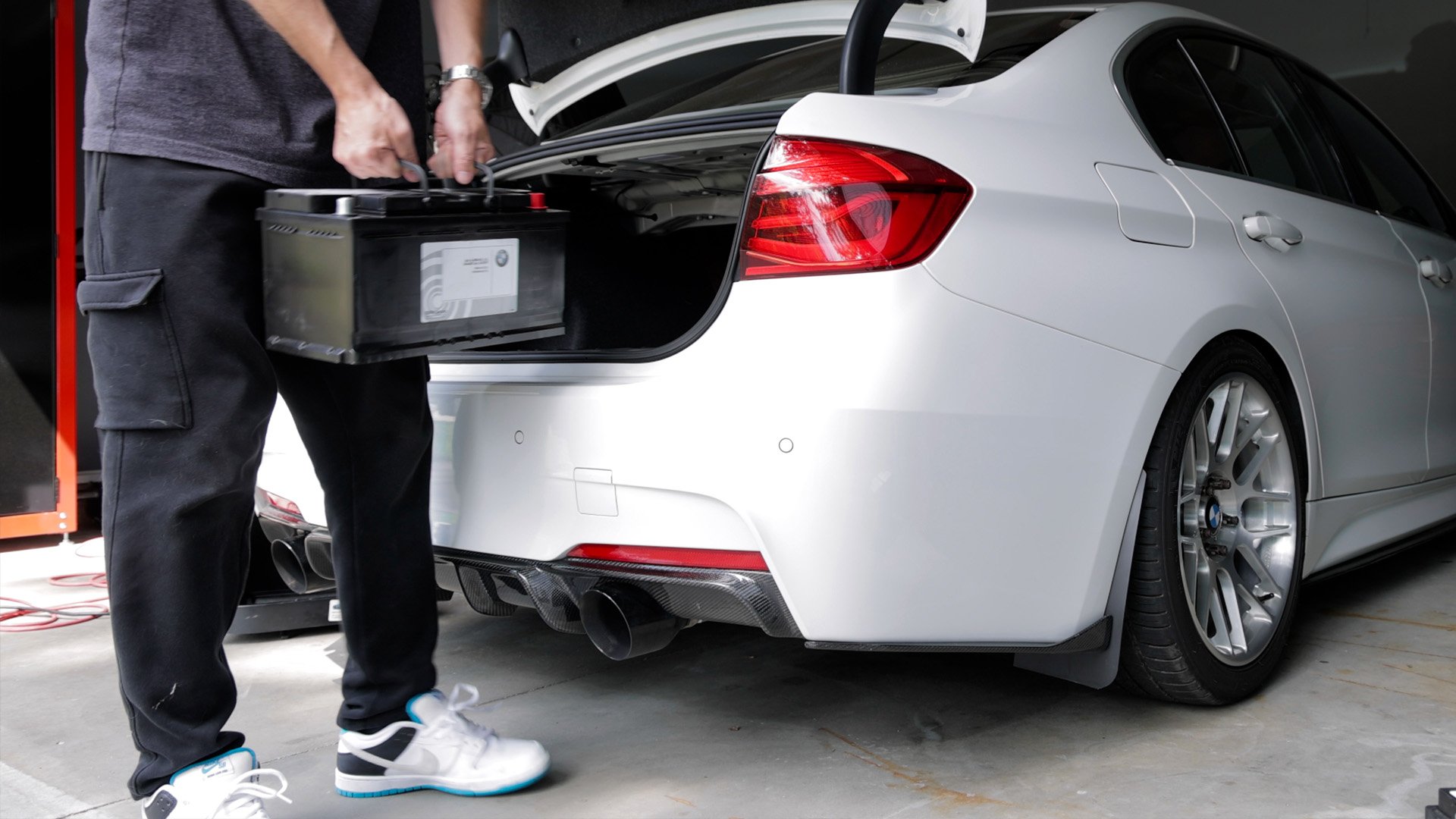
Re-assembly: Secure the 10mm bolt at the base of the battery on the negative side, and reinstall the retaining bracket. Connect the negative, then the positive cables. The torque spec for the battery terminals is 10 N⋅m, but I won’t tell anyone if you snug them up by feel. Re-connect the vent hose on the front of the battery and the physical part of the installation is complete.
Why You Must Register Your New BMW Battery
BMWs manufactured from the mid-2000s onward (including the F30 and F32 generations) use an Intelligent Battery Sensor (IBS). This system uses an algorithm to track the battery’s age and health, increasing the charging voltage as the battery gets older to ensure consistent performance.
When you install a new battery, you must register it to reset these charging statistics.
Risks of Not Registering:
Overcharging: The car will treat the new battery like an old one, sending too much voltage.
Reduced Lifespan: Overcharging leads to premature battery failure.
Component Damage: Excessive heat from overcharging can damage sensitive electronics.
BMW Battery Registration vs. Battery Coding
It is important to know the difference between these two steps to avoid electrical issues.
Registration: Telling the car a new battery of the same specs has been installed. This resets the charging counter.
Coding: Telling the car that the physical specs (Amp-hours or Battery Type) have changed.
Note: If you are installing a battery with the same specs as your old one, you only need to register. If the new battery specs are different, you will need to code first, then register.
Registering a battery with Carly
Step 1: Plug the Carly adapter into your car’s OBD II port. Press the ignition button once to put your car into accessory mode (without starting the engine), then open the Carly app on your phone and press “Connect.”
Step 2: Select “Features” in the lower right corner, then under “Maintenance,” select “Battery Reset.”
Step 3: Register the battery. You can choose to “Register Same Battery” if the capacity and type are the same as before, or “Register New Type Battery” if the capacity or type are different from before. Since my new battery specs were the same as my old one, I chose “Register Same Battery.”
Step 4: Tap “Read Battery Data” which will show your car’s current battery statistics, then tap “Register Same Battery.” After the registration is complete, turn off the ignition, unplug the Carly adapter from your OBD II port, and the next time you start your car, it will begin recording new statistics.
If you want to confirm that the battery registration took, follow the previous steps up to “Read Battery Data,” and the mileage should show the milage the car had at the time of the registration. Prior to registering mine, the battery data showed 0 miles for the first registration (assuming it was the original battery installed at the factory) and 54,625 miles for the 2nd registration (the milage on the car when I replaced the battery).
BMW Battery Maintenance: How to Prevent Discharge

CTEK MXS 5.0 battery tender. When using a battery tender on your F30, use the connections under the hood. There is a positive post (red) near the windshield and a ground near the air intake.
BMW electronics are notorious for "parasitic draw"—small amounts of power used by the car’s security, comfort, and telematics systems even while the engine is off. If you do not drive your BMW daily, your battery is at risk of deep discharge, which causes permanent chemical damage to the cells.
Why Car Batteries Are Different From Phone Batteries
Unlike Lithium-Ion smartphone batteries that thrive on being cycled (drained and recharged), the Lead-Acid or AGM batteries in your BMW are designed to stay at a 100% state of charge.
Self-Discharge: Batteries naturally lose power over time, a process accelerated by cold weather.
Irreversible Damage: Allowing a car battery to drop below a certain voltage causes sulfation, significantly shortening its lifespan and capacity.
If your vehicle sits for more than two weeks, the alternator won't have the opportunity to replenish the lost energy. In this scenario, a battery tender (or trickle charger) is an essential investment.
My Recommendation: CTEK MXS 5.0
The CTEK MXS 5.0 is widely considered the industry standard and is the actual manufacturer behind many "Genuine BMW" branded chargers.
Smart Charging: It uses an 8-step program to analyze, charge, and maintain the battery.
Temperature Compensation: It adjusts the charge based on ambient temperature (critical for winter storage).
Recond Mode: A special feature that can sometimes "revive" a deeply discharged battery.
Pro Tip: For BMW F30/F32 owners, always connect your battery tender to the dedicated charging terminals under the hood, rather than the battery in the trunk. This ensures the Intelligent Battery Sensor (IBS) accurately tracks the incoming charge.